THE PLAYBOOK + INTEGRATED TRAINING & IMPLEMENTATION PROGRAM
(LIVE ON ZOOM)
Main hero to follow
DELIVERED BY BEST PRACTICE GROUP AND NAGARIS


Australia’s AML/CTF Reform Key Dates
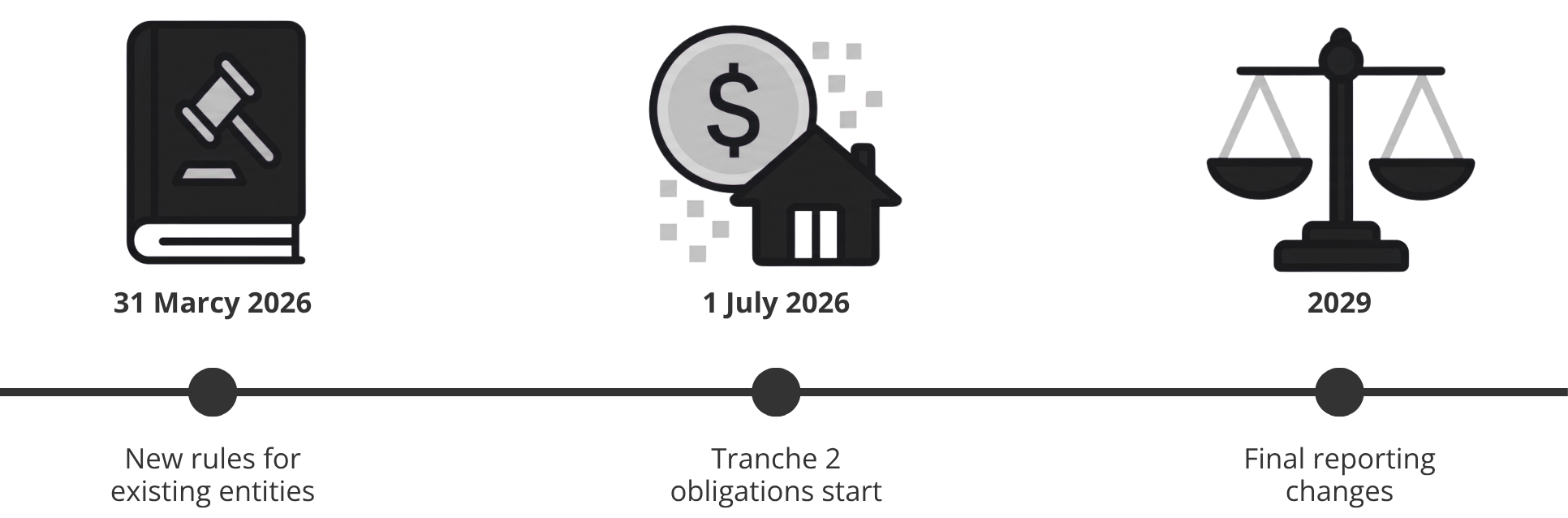
From 1 July 2026, accounting firms providing designated services are regulated reporting entities under Australia’s AML/CTF regime. That is not a compliance “project”. It is an operating standard with real obligations, real scrutiny, and real consequences.
As a partner, you are carrying three non-negotiables whether you like it or not:
- Your firm must be operational (not just documented).
- Your people must be trained (and you must be able to prove it).
- Your decisions must be defensible (especially when a client pushes back).
Most firms will produce a document and call it a program.
AUSTRAC will not be assessing your intentions. It will assess your controls and your evidence.
This program exists to give you both: an operational AML/CTF system your firm can actually run, and an evidence trail you can stand behind.
Built for partners: protect the firm
without turning it into a bureaucracy
If you are thinking any of the following, you are exactly who this is for:
- “We do structures, SMSFs and advisory, we are exposed, but I don’t want to strangle the firm with admin.”
- “My team avoids asking long-standing clients for identity documents. They’ll cave.”
- “Partners will override the process the first time a good fee walks in.”
- “We are worried about tipping off, and nobody is confident about what to say.”
- “We want training evidence and certification for staff, not a tick-the-box webinar.”
This program is designed for real-world practice conditions: urgency, scope creep, imperfect clients, and commercial pressure.
A Fully Integrated Delivery:
Best Practice Group and Nagaris
This is not training in isolation. It is training + implementation + integration delivered as one system:
- Best Practice Group: Partner accountability, best-practice operating standards, practical workflows, quality assurance
- Nagaris: Implementation support so the workflow and evidence trail are embedded where your firm actually works
The objective is simple: close the gap between “we trained people” and “we operate the standard”.


Two live, digestible partner-grade sessions (Zoom)
- Part One (2 hours) – May: Onboarding + client acceptance operating system
- Part Two (2 hours) – June: Monitoring + escalation + tipping off + evidence + certification
This is an operational drill, not a lecture. Your team practices the workflow, completes the tools, and makes documented decisions.
The Accounting Firm AML/CTF Playbook (authoritative reference)
A complete operational guide (23 chapters plus appendices) that anchors the why, what, and how, across scoping, CDD, beneficial ownership, monitoring, escalation, tipping off, engagement letters, culture, training evidence, and file hygiene.
Online self-assessments for each submodule (self-paced option included)
Each submodule includes an online self-assessment so staff who cannot attend live (or who join late) can complete the program in a structured, evidence-based way, without you carrying the risk of “missing training”.
Certification for every participant (including employees)
Certification is issued on completion of requirements supported by:
- Participation evidence and
- Scenario-based assessment evidence.
You can demonstrate training occurred, understanding was tested, and completion was recorded.
Best-practice quality assured implementation (partner-backed)
This program is built around:
- Standardised workflows (the firm runs one process, not ten personal versions)
- Clear responsibilities (RACI)
- Partner non-negotiables that prevent “override for a fee” behaviour
- Documented decision-making
- A defined minimum evidence set for designated service matters
Audit-ready evidence trail (training + assessment + certification)
You will be able to evidence:
- Who was trained
- What they were trained on
- When training occurred
- That staff were assessed
- What operational controls were adopted
- That the program is being implemented (not just written)
This is the difference between “we did training” and “we can prove it”.